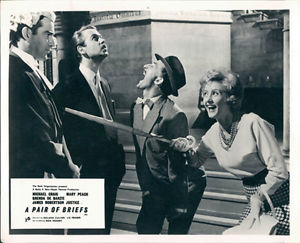
Two weeks ago I made a rather delayed trip (thank you British weather) to the British Film Institute on London's Southbank. As I've mentioned over on Twitter, the BFI hold the entire Gerald Thomas archive which is chock full of delightful artifacts from Gerald's long, varied and illustrious career in British film. I was quite frankly dazzled by the array of material on offer and have only managed to flick through a fraction of it, but this blog today is the start of several pieces looking at different aspects of what I've had the very good fortune to see.
I started
off looking at one of Gerald Thomas’ scrapbooks. Gerald kept meticulous records
of all the films he directed and these scrapbooks provide a fascinating insight
to the publicity machine behind the success of the Carry On films. Gerald took
an intense interest in how the films were perceived in both the national and
regional press and as well as organising countless promotional shoots, tit bits
and interviews, he also kept reviews from a wide range of publications.
What struck
me immediately when I started to flick through the scrapbook for the 1972 film
Carry On Abroad, was how old fashioned the reporting was. There was a definite trend
towards using the often new, glamorous young actresses from the film to help
sell it at the box office. Of all the cast of Carry On Abroad, there are
endless photo features and little interviews with the likes of Sally Geeson,
Carol Hawkins and Gail Grainger. Sally and Carol, both then in their early
twenties are frequently described as “dollies” or “dolly birds” while Barbara
Windsor is “pert”, “bouncy” and “bubbly”. Nothing mentioned about their acting
talents you might notice!
Barbara
Windsor, by then a main draw for the series, was interviewed by Margaret Pride
for Reveille magazine. Even though
the journalist was female, she was obviously still under the guidance of her
male bosses as the following description of Miss Windsor shows: “She is
nearly 35 and has a fabulous skin with not a wrinkle in sight. She says she can
look like a twenty year old floosie, why make the most of it after all?” I can’t
really imagine actresses wishing to be portrayed in such a fashion these days.
Carol
Hawkins, fresh from success in the big screen version of Please Sir and the
spin off television series The Fenn Street Gang, was also garnering a fair
amount of publicity for the film. This was Carol’s first with the Carry On
team, despite having filmed a uncredited cameo in the Thames Television Carry
On Again Christmas special back in 1970. Hawkins would go straight on from filming
Abroad to playing Kate Baines, daughter of Terry Scott and June Whitfield, in
the Peter Rogers/Gerald Thomas film of Bless This House, also filmed at
Pinewood in 1972.
The Sunday Express reported that Carol
announced her engagement at the Carry On Abroad end of picture party. There was
a great deal of publicity on the wedding, which took place at Northaw Church on
25 June that year. Carol was born and raised in Barnet, North London, and the
local paper, the Barnet Press, carried
a story “Wedding Bells for Carol”. The paper noted that the reception, where
the happy couple of Carol and new husband, electrician John Brown would greet
their guests, would take place at the Terenure Country Club in Totteridge,
North London.
And if
you’re interested, Gerald also kept a clipping which gave details on Carol’s
wedding attire. Under the headline “Sunshine Look for Bo-Peep Bride” we learn
that Carol wore a bo-peep style chiffon dress with a rose decorated picture
hat. Well it was 1972…
Another
headline describes Miss Windsor in the following glowing terms: “What A Carry
On for Bouncy Barbara” – yet again the newspapers focussing on Barbara’s
appearance rather than the fact she was just finishing a five month run on the
West End stage in The Three Penny Opera.
A quite
frankly hilarious colour article is also pasted into the scrap book, this time
featuring a young Sally Geeson. Sally, already a name on the small screen
thanks to her prominent role as Sid James’ daughter in Bless This House, is
featured in “Fashion Chat” with Diana. We glean the following fascinating
insight into young Sally’s sense of style. Apparently Sally liked “pretty
frocks” and her main fashion tip was “for casual wear, smock top and
plimsolls!” How enlightening.
In a more
serious piece, entitled Carry On Sid, journalist Bruno Broffenbrenner went to
meet the series’ leading man Sidney James. In quite a frank interview, of the
kind that’s pretty rare these days, Sid briefly talks about his decision to
focus on comedy parts: “I’ve played a couple of serious parts and made a bloody
mess of them that I just don’t want to know anymore”. I think Mr James is being
far too hard on himself. I’ve certainly seen evidence of his great depth and
range as an actor on screen. “Seriously though, I’m not that good an actor- I’m
a re-actor. I never wanted to be a star because I’m very far removed from being
a star. I’m a chief supporting actor and as that you get a long life”. I think this is typical of Sid James – his down
to earth everyman modesty was a bit factor in him becoming that star he claimed
not to want to be. Everyone in the audience knew a Sid, was a Sid or had a Sid
as a husband, son, father or brother.
The article
concluded as Sid is called back to work on Carry On Abroad: “The final call
comes and Sid jogs off, stopping mid-way to exclaim ‘ Why the heck am I
running? Struth! This picture’s already three days ahead of schedule! I don’t
want to put anybody out of work!”. I think these snippets show the real man behind the famous Sid laugh and the lusty on screen antics. And it was a joy to read.
Stay tuned for the next in my series of special blogs on Gerald's archive coming up soon!