Showing posts with label Dirk Bogarde. Show all posts

Thursday, 28 March 2019

Remembering Dirk Bogarde


The majestic Dirk Bogarde was born on this day in 1921. I first became aware of Bogarde through his deliciously light touch starring roles in the Betty Box hit film series, the Doctor films. Growing up on a diet of Carry On comedies, the more innocent, slightly classier Doctor comedies were a natural progression and I sought them out with the appetite of a young film lover discovering yet more wonderful treats.

For years I knew Dirk only as the affable, occasionally bumbling yet always suave Dr Simon Sparrow. The young doctor who became romantically involved with the likes of Muriel Pavlow, Shirley Eaton, Kay Kendall and even Brigitte Bardot. Dr Sparrow was part of a very talented gang which also included the likes of Donald Houston, Donald Sinden and Kenneth More. The early Doctor films, In the House (1954), At Sea (1955) and At Large (1957) are wonderful period pieces packed full of the very best of British character actors. They are gentle pieces of fluff these days but packed out cinemas across the land. 

Such was the star quality of Dirk Bogarde that the later films in the run, those without him, failed to spark in quite the same way. They featured top class actors like Leslie Phillips and Michael Craig, but Dirk had something special. They may not have changed the world but well not all cinema needs to do that. Absolutely nothing wrong in 85 minutes of innocent escapism and that sentiment is as true and valuable now as it was then. In a BBC Omnibus interview back in the early 1980s, a more mature, reflective Bogarde was asked if he regretted all those light comedies. His answer? Not a bit! He didn't dress them up as anything other than what they were - money makers and crowd pleasers but he definitely did not appear either snobbish or ashamed about his part in them. Dirk also helped calm the nerves of a certain young actress making her first significant mark in film - in 1954 Joan Sims shared one beautifully comedic scene in Doctor in the House with Dirk. In her autobiography Joan noted Dirk's gentleness, his kindness and his charm. If he's alright by Joanie, he's alright by me.


As the years have passed I have discovered many of Dirk's other big screen performances and there are so many to cherish. Thanks to the consistently brilliant Talking Pictures TV, I have been able to track down and enjoy several other films from Dirk's back catalogue and it's been a wonderful voyage of discovery. I love Dirk's turn as a dangerous, devious delinquent in the 1949 crime drama, The Blue Lamp. The film is best known for leading to the long running BBC police drama, Dixon of Dock Green. In a cast full of eye catching talent and first rate performances, Dirk steals the limelight as the anti-hero Tom Riley. It's an arresting performance, pun intended, and one I return to again and again. It's about as far removed as Simon Sparrow as you can get. 

More was to come of course and other favourites include his delightfully light and frothy turn as Tony Howard in For Better For Worse in 1954. Starring as a young, naive couple setting out on the road to marriage and independence, Dirk forms a really sweet starring partnership with Susan Stephen as the 1950s couple trying to convince her parents and everyone else in their orbit that they can make it in the world. It paints a picture of a world long gone, probably one that never really existed for most of us, but it's beautifully portrayed and is a perfect rainy Saturday afternoon matinee film. It also boasts a gaggle of brilliant supporting turns from the likes of Thora Hird, James Hayter, Sid James, Cecil Parker and Athene Seyler. 


Dirk was back on deliciously evil form as the villain in the 1955 British film noir, Cast A Dark Shadow, in which he plays a seductively dark young man with a predilection for bumping off wives. Directed by the legendary Lewis Gilbert, this suspenseful drama co-starred the amazing Kathleen Harrison, Kay Walsh and Margaret Lockwood. The following year Dirk starred alongside Michael Hordern and Jon Whiteley in the classic technicolour drama, The Spanish Gardener. The film follows the story of the novel of the same name, relating how Nicholas's (Whiteley) innocent love for his father is destroyed by the latter's jealousy and vindictiveness when Nicholas forms a friendship with the young Spanish gardener, José Santero, played by Bogarde. 

I also love Dirk's starring role as Sydney Carton in the Ralph Thomas directed 1958 film A Tale of Two Cities. Co-starring Dorothy Tutin, Stephen Murray, Cecil Parker and Athene Seyler, Dirk is on dashing form as Sydney, a drunken English lawyer whose conscience is pricked when a man he once defended tries to escape the guillotine during the French Revolution. I can't go any further without mentioning the legendary 1961 film, Victim, in which Bogarde starred as a hugely successful London barrister, Melville Farr, who on the surface leads the perfect life. Married to Laura (Sylvia Syms), Melville has a secret life involving romantic relationships with men. The Basil Dearden directed film was the first English language film to use the word 'homosexual' and although its themes may sometimes appear dated today, it was and remains a hugely influential film. It took courage and determination from all those involved to get it made and it played heavily against type for Dirk Bogarde, himself a gay man. 
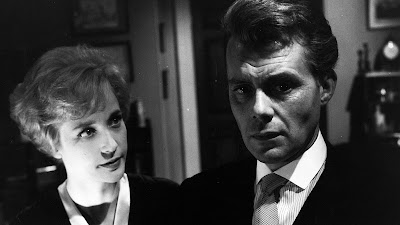


As the 1960s progressed and Dirk parted company with the light comedies of Betty Box and Ralph Thomas, he chose a different path which saw Bogarde take on more challenging roles in films like The Servant in 1963. This darkly psychological drama shot in crisp black and white by Joseph Losey and written by a certain Harold Pinter. The film focusses on four central characters, played superbly by Bogarde, Sarah Miles, Wendy Craig and James Fox. The main themes of the film are very timely for the era in which it was made - class, servitude and the changing face of the British upper class. It's a superb study and Bogarde shines. 

Dirk's film career faltered in the later 1970s following surprising and sometimes controversial roles in films like Death in Venice in 1971 and The Night Porter three years later. He continued to appear sporadically until the late 1980s but long before that he had begun to shun the limelight and concentrate on writing. I am poring over the several volumes of Dirk's memoirs at the moment and they provide a fascinating insight into the great man. His rise to stardom, his struggle with his subsequent fame and his relationships with famous friends and family. His writing is as elegantly constructed as the man himself. I loved the descriptions of his friendships with such exotic characters as Kay Kendall and Judy Garland. At times his writing is delightfully bitchy, at others reflective, maddening, charming and searingly honest. It leaves me completely fascinated with Sir Dirk Bogarde even if at times I think I might not always got on with him. 

As we remember Dirk today, we should highlight what a superbly talented film actor he was. Quintessentially British, he was a leading man in the golden age of British cinema. Delicate, complex, technically brilliant, Dirk was a master of his craft and was at home in everything from light comedy to dark psycho drama. Suave, daring, devilishly handsome, Dirk was very much a product of his era and yet he's still a joy to watch today. 


So pull out your favourite bit of Bogarde and raise a glass to this most elegant of British screen stars. 


You can follow me on Twitter @CarryOnJoan and on Instagram


Thursday, 21 March 2019

Talking Pictures: Great British Comedies


This afternoon BBC2 repeated a great little documentary first shown a few years back. Talking Pictures, not to be confused with the brilliant Talking Pictures TV channel, is a series profiling well known names from the past in classic films both in Britain and beyond. Narrated by screen icon Sylvia Syms, this particular edition looked back at the glory days of British film comedy.

Featuring rarely-seen interviews and classic clips from the BBC archives, this episode sees many of our favourite stars take a bow. From the early pre and post war days of George Formby to the classic Ealing comedies, Carry On fans won't be disappointed as eventually both the Doctor and the Carry On series are covered. There is some archive footage of leading man Dirk Bogarde, giving a revealing and insightful interview for the BBC series Omnibus in 1983 and black and white clips of a young Joan Bakewell chatting with the legendary actor James Robertson Justice.

The programme then goes on to talk about the Carry Ons. Here we get some classic interviews from the 1970 Carry On Forever documentary which went behind the scenes of Carry On Up The Jungle. I've featured this show before, but it's always great to see the likes of Gerald Thomas, Sid James, Joan Sims and Charles Hawtrey out of character and relaxed as themselves. It's a rare treat. 

The programme also touches on Peter Sellers' work on the Pink Panther films and later comedy efforts from the Monty Python films, the John Cleese picture A Fish Called Wanda and more recent films like Four Weddings and a Funeral. Anyway, never mind these also-rans, tune in for the classic clips of Bogarde, James and Sims. It's superb.


You can watch the programme here: Great British Comedies.

You can follow me on Twitter @CarryOnJoan and on Instagram

Saturday, 18 August 2018

Carrying On With a … Doctor in Distress


This is part of a brand new series of blogs looking back at the wonderful series of British comedy films - the Doctor … series. There were seven Doctor films produced at Pinewood Studios between 1954 and 1970, all with Betty Box and Ralph Thomas at the helm. With Betty being Peter Rogers' wife and Ralph the brother of Gerald Thomas, there were bound to be a fair few Carry On connections.

These medical comedy films were extremely popular at the time and while perhaps they do not have the lasting appeal of the Carry Ons, there is no doubting their classic status. Always looking more lavish than their sister films in the Pinewood stable, they did share a cosy ensemble feel with many familiar faces appearing again and again over the years.

So let's continue today by looking at the fifth film in the Doctor series, which saw the return of a very familiar face for the last time, 1963's Doctor in Distress.


What's it about?

Simon Sparrow, now a senior doctor at Hampden Cross Hospital, falls in love with Delia, a model and aspiring actress. They eventually move in together, but then she goes to Italy to try out for a film.
Meanwhile, Spratt injures his back in a fall. Placed under the care of physiotherapist Iris Marchant, he is initially hostile, but soon succumbs to her charms. He turns to his friend Simon for advice. Simon sends him to a nature cure clinic in a vain attempt to help him lose weight. Spratt has Iris followed, and, when his private investigator turns up at Hampden Cross as a patient, follows her himself (terrorising a nervous train passenger in the process). He proposes to her, but is eventually rejected in favour of another of her patients, retired army Major Tommy French.
Delia returns in England, having somehow acquired an expensive Italian car and expensive clothes, though she did not land a part in the film. It is implied that she and Simon get together again.

Who's in it?

Dirk Bogarde returns to the Doctor films for the first time since Doctor At Large in 1957 and for his fourth and final film in the series. Joining him once again is James Robertson Justice as Sir Lancelot Spratt while Doctor in the House original actor Donald Houston returns, although this time playing a different character.

Also starring are Samantha Eggar as Delia Mallory, Barbara Murray as Iris Marchant and Mylene Demongeot as both Sonia and Helga.

Carry On faces?

Following on from the previous film, Doctor in Love, Distress sees a huge cast of familiar Carry On faces trot across Pinewood Studios to join in the fun for Betty Box and Ralph Thomas. As already mentioned, Donald Houston, returns to the Doctor films. Donald played a major supporting role in Carry On Jack made the same year as this film.

Returning for her second Doctor film is Carry On Regardless and Screaming star Fenella Fielding, playing a rather distraught train passenger. Carry On Constable supporting actress Jill Adams plays in her second Doctor film in the role of Genevieve. Also look out for future Carry On Cleo leading lady Amanda Barrie who has a cameo role as Rona. Amanda made her Carry On debut this same year, 1963, as Anthea in Carry On Cabby.


Carry On Cruising actor Ronnie Stevens appears as a Hotel Manager while future Carry On legend Peter Butterworth plays the small role of an Ambulance Driver during the opening credits and the first few scenes of the film. Towering actor and stunt man Joe Robinson, who sadly passed away just last year, appears briefly as Sonia's boyfriend. Three years earlier he played Dynamite Dan the boxer in Carry On Regardless.

The renowned actor John Bluthal, who appeared in Carry On Spying, Follow That Camel and Henry, plays a Railway Porter while taking on the part of a Cafe Waitress is none other than the amazingly prolific Marianne Stone. And in the uncredited role of a medical student (alongside other such famous names as Christopher Beeny and Richard Briers) is future Coronation Street legend Johnny Briggs. Johnny went on to play small parts in Up The Khyber, Behind and England. Finally, there is a small uncredited appearance by Hilda Fenemore as a Railway Station Barmaid. Hilda played Brian Oulton's wife in Carry On Nurse and a lady in need of a copper (!) in Carry On Constable.


Did you know? 

One of the ten most popular films at the British Box Office in 1963.

Although some ideas were taken from the books of Richard Gordon, this film did not come from one of Gordon's books.


You can follow me on Twitter @CarryOnJoan and on Instagram

Monday, 9 July 2018

Carrying On with a … Doctor At Sea!


This is part of a brand new series of blogs looking back at the wonderful series of British comedy films - the Doctor … series. There were seven Doctor films produced at Pinewood Studios between 1954 and 1970, all with Betty Box and Ralph Thomas at the helm. With Betty being Peter Rogers' wife and Ralph the brother of Gerald Thomas, there were bound to be a fair few Carry On connections.

These medical comedy films were extremely popular at the time and while perhaps they do not have the lasting appeal of the Carry Ons, there is no doubting their classic status. Always looking more lavish than their sister films in the Pinewood stable, they did share a cosy ensemble feel with many familiar faces appearing again and again over the years.

So let's continue today by looking at the follow up to the hugely successful Doctor In The House, the 1955 film Doctor At Sea. 


What's it about?

With a view to escaping his employers' daughter, who has amorous designs on him, Dr Simon Sparrow (Bogarde) signs on as medical officer on a cargo ship, "SS Lotus". The ship is commanded by hot-tempered and authoritarian Captain Wentworth Hogg.
Sparrow overcomes initial seasickness and settles into life on board. After arriving in a South American port (unspecified, but possibly in Ecuador), Sparrow meets Hélène Colbert , a sexy young French nightclub singer.
The misogynist Captain Hogg is forced to take on two female passengers, Muriel Mallet, the daughter of the chairman of the shipping company, and her friend, Hélène, for the return trip. Romance blossoms between Simon and Hélène, and when they reach home, Helene receives a telegram offering her a job. She and Sparrow return together.
Throughout the trip, Hogg has been romanced by Muriel and eventually becomes engaged to her - with almost certain promotion to Commodore.

Who's in it?

Dirk Bogarde stars once again as Simon Sparrow, indeed he is the only actor from the original film to reprise the same role. James Robertson Justice also returns but in the different role of Captain Hogg. 

Also starring is Brenda De Banzie as Muriel Mallet and a certain Brigitte Bardot as Helene Colbert. Familiar character actor Maurice Denham also appears as Steward Easter.

Carry On faces?

Joan Sims is back for her second outing in a Doctor film, this time playing unlucky in love Wendy, who takes rather a shine to Dr Sparrow! Playing Wendy's mother is the actress Joan Hickson, another face making a return appearance.


Carry On Nurse guest star Michael Medwin grabs a leading role as Sub-lietenant Trail while  Carry On Constable supporting actress Jill Adams plays the aptly named Jill. Returning after the first film the previous year is reliable supporting actor Cyril Chamberlain, here playing Whimble. 

Also keep your eyes peeled for the legendary Fred Griffiths in an uncredited role as a Seaman and apparently also future Carry On Teacher and Cathy Come Home star Carol White in an uncredited bit role.


Did you know? 

Doctor At Sea was Brigitte Bardot's first ever English speaking film.

The film was nominated for a 1956 BAFTA Film Award for Best Screenplay.

Doctor At Sea was the third most popular film at the British Box Office in 1955, after The Dam Busters and White Christmas. 


You can follow me on Twitter @CarryOnJoan and on Instagram

Wednesday, 4 July 2018

Carrying On with … A Doctor in The House!


This is part of a brand new series of blogs looking back at the wonderful series of British comedy films - the Doctor … series. There were seven Doctor films produced at Pinewood Studios between 1954 and 1970, all with Betty Box and Ralph Thomas at the helm. With Betty being Peter Rogers' wife and Ralph the brother of Gerald Thomas, there were bound to be a fair few Carry On connections.

These medical comedy films were extremely popular at the time and while perhaps they do not have the lasting appeal of the Carry Ons, there is no doubting their classic status. Always looking more lavish than their sister films in the Pinewood stable, they did share a cosy ensemble feel with many familiar faces appearing again and again over the years.

So let's start off today by looking at the very first in the series, the brilliant, evergreen Doctor in The House from way back in 1954.


What's it about?

The story, based on the novel by Richard Gordon, follows the fortunes of Simon Sparrow, starting as a new medical student at the fictional St Swithin's Hospital in London. His five years of student life, involving drinking, dating women, and falling foul of the rigid hospital authorities, provide many humorous incidents.
Simon's friends cajole him into a series of disastrous dates, first with a placidly uninterested "Rigor Mortis", then with Isobel, a woman with very expensive tastes, and finally with Joy, a nurse at St Swithin's. After a rocky start, he finds he likes Joy a great deal.
The climax of the film is a rugby match with a rival medical school during Simon's fifth and final year. After St Swithin's wins, the other side tries to steal the school mascot, a stuffed gorilla, resulting in a riot and car chase through the streets of London. 

Who's in it?

This first film in the series introduced us to many characters who would appear throughout the run, on and off. It also confirmed the star status of its leading man, Dirk Bogarde, who played Simon Sparrow. Playing Simon's fellow students were Kenneth More, Donald Sinden and Donald Houston while the unforgettable James Robertson Justice took on the role of the fearsome Sir Lancelot Spratt, a character he'd become synonymous with for the rest of his life.

The film also boasted two delightful leading ladies in Muriel Pavlow, playing Joy and Kay Kendall, fresh from success in Genevieve, in the role of Isobel. 


Carry On faces?

Quite a few! Making the first of several appearances in the Doctor series is the wonderful Joan Sims, here playing the eye catching cameo role of Nurse Rigor Mortis! It was a small part but it really did help establish Joan in films and led to many more comedy roles for Betty and Peter at Pinewood. 

As I've already mentioned, future Carry On Jack star Donald Houston was one of the main stars of the film, playing Welsh rugby obsessed student Taffy Evans. Another actor making the first of several appearances in the series is Carry On semi-regular Harry Locke, here playing Jessup. Harry went on to play supporting roles in the first three Carry Ons with a medical theme.

The original Carry On leading lady, Shirley Eaton, makes the first of two appearances in the Doctor films with her role here as Milly Groaker. This marked one of Shirley's earliest film performances. And playing Shirley's mother in the film is another very familiar face, Joan Hickson.

Cyril Chamberlain, a reliable supporting actor in the first seven Carry Ons, plays a Policeman while Brian Oulton, a great addition to the casts of Carry On Nurse, Constable, Cleo and Camping, pops up as a Medical Equipment Salesman. Finally, playing another salesman is that instantly recognisable character actor and co-star in Carry On Spying, the superb Richard Wattis.


Did you know? 

The film was nominated for four BAFTAs in 1955, winning a Best Actor Award for star Kenneth More.

Nicholas Phipps, who wrote the screenplay based on Richard Gordon's book, also plays the role of the Magistrate in the film. Gordon also has an uncredited role as an Anaesthetist.

Apparently Robert Morley was first choice to play Sir Lancelot Spratt however Box and Thomas refused to pay the £15000 fee his agent demanded. The part then went to Robertson Justice for a fraction of this fee.

The film was a huge success, recouping its original budget within six weeks of initial release. Box Office receipts confirm that the film was seen by over 15 million people, a third of the entire British population at the time.


You can follow me on Twitter @CarryOnJoan and on Instagram

Thursday, 12 January 2017

How They Came To Carry On ... Shirley Eaton


The glamorous girl next door Shirley Eaton enlivened several early, rather coy black and white Carry On films. She was the young female lead in the very first in the series, Carry On Sergeant, playing Mary Sage, the new young wife of lead character Charlie, played by Bob Monkhouse.

In a very male dominated National Service comedy, Eaton's performance stood out and it was no surprise to see her back later in 1958 for a starring role in the smash hit, Carry On Nurse. Released in 1959, Nurse performed strongly not just in the United Kingdom but also on the other side of the Atlantic. As Nurse Dorothy Denton, Shirley shone and her romantic storyline alongside Terence Longdon added a strong backbone to all the knockabout comedy provided by the likes of Kenneth Connor, Kenneth Williams and Joan Sims. Shirley made her final Carry On in late 1959 when she came back to Pinewood for a cameo role as Sally Barry in the police comedy, Carry On Constable.


Shirley only had two or three scenes in Constable, however Rogers and Thomas were obviously keen to feature as many familiar actors in the film as possible. Her scenes with Leslie Phillips were great fun and the pair had delicious chemistry. Sadly Shirley did not appear in any further Carry Ons. I remember the actress saying she didn't think the characters she played would have fitted with later, ruder entries in the series, and I can understand that. However I wish she had appeared in a few more early 1960s Carry Ons. Of course Eaton retired from acting by 1969 so there would have no 1970s Carry Ons for her anyway. 

However, what brought Shirley Eaton to the attention of the Carry On producers in the first place? How did she come to Carry On? Acting from a very young age, Shirley trained at the Aida Foster's school in North London, taking to the stage as a girl. Breaking into television in the early days of the medium, Shirley appeared frequently with the duo of Terry Scott and Bill Maynard in Great Scott! It's Maynard! Before Shirley came to work for Peter Rogers, she first of all acted in films produced by his wife, the legendary Betty Box. 


Shirley has spoken of how Betty spotted her playing the small role of a harem girl in the 1954 comedy film You Know What Sailors Are. On the basis of that small role, Box cast Shirley in the first ever Doctor comedy, Doctor in the House, released later that same year. Playing the small role of Milly Groaker, Shirley shared scenes with Dirk Bogarde as Simon Sparrow and Joan Hickson, playing her mother. This eye-catching guest role led to Box casting Eaton in a further Doctor film, Doctor At Large, in 1957. In this film she had the larger role of Nurse Nan McPherson. There is no doubt that becoming a reliable actress in the Doctor comedies played a part in Rogers and Thomas adding Eaton to the line up for their own fledgling comedy series.

If Peter Rogers went regularly to the cinema in the 1950s, and I believe both he and Gerald Thomas did, he would have seen Shirley star in a further two important and popular broad comedy films. The first of these, Sailor Beware! was a translation of Falkland Carey's successful stage play. Eaton played Shirley Hornett and the film centred on the plans for her wedding to Albert Tufnell, played by future Nurse On Wheels star, Ronald Lewis. Peggy Mount played the formidable mother, Emma and she was ably assisted by the likes of Esma Cannon, Gordon Jackson and Geoffrey Keen. The film was a huge success as was the wonderful comedy The Naked Truth, released in 1957.


The Naked Truth is a glorious British comedy, directed by Mario Zampi. The Naked Truth sees the editor of a famous scandal magazine and focuses on the attempts of various high profile figures to despatch the troublesome Nigel Dennis, before he can ruin their careers. Dennis played by the reliably suave Dennis Price. Shirley Eaton plays the young starlet Melissa Right and is given superb support by the likes of Terry-Thomas, Peter Sellers, Joan Sims and Peggy Mount. Quite a cast! 

Given the films Shirley was making and the people she was working with, it was surely only a matter of time before she worked for Peter Rogers. Of course this is all with the benefit of hindsight, but I'm glad Peter did cast Shirley in those early Carry Ons. In doing so he began a fond tradition of the Carry On blonde. While the likes of Liz Fraser, Angela Douglas and Barbara Windsor would follow, Shirley Eaton was the first and a proper Carry On original.


You can follow me on Twitter @CarryOnJoan and also on Facebook

Tuesday, 11 October 2016

How They Came to Carry On ... Dilys Laye


The lovely Dilys Laye has always been one of my favourite actors. Throughout her career Dilys tackled almost every aspect of the acting profession, from Carry On comedy to soap opera, live theatre, musicals and even a one woman show. Dilys was such a talented lady and always a cheerful, upbeat presence.

Dilys was also very obviously incredibly proud of her Carry On connections. Speaking on the DVD commentaries for both Carry On Cruising and Spying in 2006, she found the films fresh and funny and clearly loved her association with these low budget, innuendo-encrusted films. She was also full of praise for her colleagues, particularly the likes of Kenneth Williams and her life-long friend, Joan Sims. During her long career, Dilys found time to appear in four Carry Ons and I know many fans agree with me that she should really have appeared in more. Dilys herself said she wished she'd been in every single one as they were so much fun to make.


During the 1960s, Dilys appeared as the tiggerish Flo Castle, looking for a husband in Carry On Cruising; she vamped it up as double agent Lila in Carry On Spying, famous mimicking Kenneth Williams' snide character; she played Mavis Winkle, love interest to Bernard Bresslaw in Carry On Doctor and finally, the following year, she teamed up with Sid, Bernard and Joan to form the fabulous foursome in Carry On Camping. However how did Dilys first come to Carry On? 

The original story, as told by Dilys herself, was that she was brought in to play the role of Flo in Cruising at very short notice, something like two or three days. She told the story of being whisked around the West End of London to buy various outfits for the film, which apparently she got to keep at the end. Surely an uncharacteristically generous move on the part of producer Peter Rogers?! Anyway, the role of Flo was originally written by Norman Hudis for series regular Joan Sims. Joan however was apparently struck down with an illness just before filming commenced so Dilys was drafted in. Although I'd have loved to see my favourite actor play that part in Cruising, for me it's definitely Dilys' part and she fills that film with a youthful exuberance and such jolly high spirits. 

However I wonder what made Peter Rogers think of Dilys as an ideal replacement? Apart from the fact that Joan and Dilys were great mates and had already spent years touring in revues together, Dilys had already built up an impressive range of comedy film parts which must have made her the ideal choice. Most importantly she had already worked for both Peter and his wife, Betty Box.


Dilys made her debut for Peter and Betty in 1957 when she played the supporting role of Jasmine Hatchett in Doctor At Large. In that film her character had to make a play for leading man and matinee idol, Dirk Bogarde as Dr Simon Sparrow. Two years later, Dilys played an Agency Girl in the Betty Box comedy Upstairs and Downstairs, a film that boasted an all star cast of Rogers and Box rep company favourites. Probably the most significant early role for Dilys, which almost guaranteed her future appearance in a Carry On was that of Millicent Jones in one of my favourites, Please Turn Over, which was released in 1959. 

Millicent Jones is a role Dilys herself seemed to really enjoy playing. Millicent was the secretary to lead character Edward Halliday, played by the wonderful Ted Ray. Millicent is in many ways a dual role as at first she is the sweet, reliable secretary but she soon turns into a double-crossing, money grabbing gold digger! It's a delightful performance and must have been huge fun to play! Watching that film again, Dilys is one of the highlights and it's easy to see why Peter Rogers would want to capitalise on that talent and make use of Dilys in future productions.


You can follow me on Twitter @CarryOnJoan and also on Facebook

Sunday, 28 August 2016

Carry On Blogging Interview: Morris Bright (Part 1)


The hottest day of the year so far saw me travel up to Borehamwood in sunny Hertfordshire to meet Mr Morris Bright, Chairman of the legendary Elstree Film Studios. I have known of Morris for some time due to his involvement with all things Carry On for many years. Not only is Morris Chairman, he is also leader of Hertsmere Council, a member of BAFTA, a writer and a broadcaster. Above all else though, he is a fan of the greats of British comedy.
I was therefore thrilled that not only had he read my blog but also that he was happy to take part in an interview. It was an absolute joy to visit Elstree Studios and learn more about Morris’ work there, his views on the Carry On phenomenon and his memories of some of our favourite film comedy actors. I also got the chance to come face to face with a genuine, fabulous piece of Sid James memorabilia! 
In part one of my interview, I asked Morris about his role at Elstree Studios, how he became involved in the entertainment business and enjoy one or two stories about Jim Dale, Dirk Bogarde and Terry Scott….


What is it like to be Chairman of Elstree Studios and what does that role involve?
I am first and foremost a fan so it’s a real pleasure to be the Chairman of Elstree and I’m very fortunate to have the role. Elstree Studios is actually owned by the local council (Hertsmere) and it’s a real going concern and very successful, particularly in the last five years or so. A successful Elstree Studios is also very good for the local area. I am also leader of Hertsmere Council but I didn’t get the Chairman role just because I lead the council – it was really because it was felt by background in the entertainment business would help in the role. 
Elstree is a small studio with really only 12 people overseeing the running of the site. We provide facilities for a wide range of film and television productions and offer something really unique because we are a small studio and we really are like a family. I am very much of the belief that we should celebrate the rich history of Elstree and all it has achieved in the past while always looking forward towards the latest opportunities and developments. Nostalgia is very popular these days and we celebrate that with frequent events looking back at Elstree’s achievements however I also believe that as a business, Elstree Studios must always look to the future. 


What was it like to be involved with the 90th anniversary of Elstree Studios book?
It really came about because we realised there hadn’t been a book celebrating all that Elstree had achieved over the years. There is so much history in the place and it was very much about celebrating that but also celebrating more recent successes and the rejuvenation of the studios over the last few years. It was also about remembering how close the studios came to disappearing in the 1990s. I love the process of research a book like that and it’s the pictures that tell the story, they are the most important part of any of the books I’ve written. Having access to the archives at Elstree and Pinewood is like a dream come true for me, as a fan. I love discovering different parts of the archive and sharing these wonderful images. 
It’s such a shame that the off cuts from the Carry Ons were destroyed.
Yes I actually met the man who was responsible for destroying all the outtakes and footage that didn’t make the final cut. When the decision was taken it was genuinely believed there would be no interest in that stuff. The Carry Ons were out of fashion for a long time and nobody believed anyone would want to see the outtakes. I remember finding filling cabinets in the archive while researching for one of my books and these cabinets were stuck shut as nobody had touched them for decades. Extraordinary. We included some previously unseen footage in the What’s a Carry On? documentary of Phil Silvers being interviewed on the beach at Camber while they were making Follow That Camel. That footage was in a small, rusty old tin that I found on the floor in the corner of an archive room. It was amazing to be able to share it again after all those years. I also love the photos of Terry Scott and Charles Hawtrey larking about on the set of Up The Khyber and these were other photos that had long since disappeared into the depths of the archive. I enjoy sharing as many of them as possible on Twitter as everyone loves seeing them. 
What’s going on at Elstree at the moment?
There is lots going on at the moment. There is a brand new series for Netflix called The Crown, a biographical drama about the reign of Queen Elizabeth II. We also have Big Brother being filmed here at the moment and preparations for the new series of Strictly Come Dancing for the BBC. 

 
You have been involved in organising many events at both Pinewood and Elstree over the years?
Yes, I remember one of the earliest events was back in the mid-1990s to celebrate the Doctor series of films and their producer, Betty Box. Lots of stars of the films were due to attend and Betty and her director Ralph Thomas were going to be there. I was told that Dirk Bogarde had agreed to come over (he lived in France at the time) for the event although as it transpired he didn’t know it was about the Doctor films – he hadn’t really talked about them since his last, Doctor in Distress in 1963. He was quite a formidable character and nobody knew how he would react. When he arrived he was an absolute gentleman and actually stayed for several hours. He seemed really pleased to be there and taking part. He was a hero of mine and I remember watching the footage of the event afterwards and I kept seeing someone lean into shot to take photos. It turned out to be Jim Dale who was a big fan of Bogarde. It struck me that it was ok for your heroes to have heroes too. It was great. 
I saw Jim perform his one man show in London last year and it was hard to believe he was nearly 80 at the time!
Jim celebrated his 81st birthday recently and he’s extraordinary. He has such energy, keeps himself in shape and just keeps going. He told me that the show (Just Jim Dale) was exhausting but the love of performing and the reaction from the audience kept him going for eight shows a week. I think many performers are like that though. I remember seeing one of those end of the pier summer revues back in the early 1990s and the stars were Terry Scott and Jacki Piper. Before the show I’d seen an elderly man struggling along the pier and I suddenly realised it was Terry! Terry suffered from various health problems towards the end of his life but carried on acting. He went on to give an energetic and thoroughly professional performance that afternoon and it was amazing how he managed to transform himself for the show. That reminds me of a story from when I attended Terry’s funeral in 1994…

 
Go on…
I remember being in the church and Terry’s wife and daughters were all in the front row with June Whitfield and her husband Tim sitting behind them. Despite the fact that the congregation were all peers or friends of Terry, lots of people actually came up to June to offer their condolences instead of or before going to Terry’s real wife! Extraordinary how powerful television can be as obviously many people really did think Terry and June were married in real life. 

I hope you have enjoyed the first part of my interview with Morris. Stay tuned for Part Two coming up tomorrow! 


You can follow me on Twitter @CarryOnJoan and also Facebook