Showing posts with label Simon Sheridan. Show all posts

Sunday, 31 July 2016

My Carry On Blogging Year so far


It's not normally very British to blow your own trumpet (Matron!) however I wanted to do a little blog post as a round up of Carry On Blogging highlights so far in 2016. It's been quite a year and I've loved every minute of it!

I'm thrilled that the blog has now received nearly 160,000 page visits since I set it up in March 2015! July this year was the most visited month so far with nearly 17,000 views!

The blog Twitter account now has over 5,500 followers and 200 of your have "liked" my Facebook page. Thank you to everyone who tweets, follows, likes and comments - it's always great to hear from you!

I marked what would have been Kenneth Williams' 90th birthday in February with a special week of blog posts celebrating the life of the great man.


I have published a series of blogs covering each of Joan Sims' 24 Carry On performances, giving my own opinions on the roles she played.

I have started a project of blogs running through some of the lesser known Carry On supporting actors in an A - Z feature.

I have cast the net out far and wide for a range of guest blog posts to bring in different opinions on the Carry On films. I have several lined up for the next few weeks so stay tuned for that!

I visited the London Film Convention earlier in the Spring where I had the great pleasure of meeting Carry On actors Jacki Piper and Fenella Fielding. You can read about that here 


One of the biggest developments this year has been the start of my Carry On Blogging interview series. So far I have interviewed several Carry On actors, authors and interesting folks connected to the series and British comedy:

- I interviewed the lovely Angela Douglas - you can read that here 

- I caught up with the delightful Valerie Leon to discuss her new Forever Carrying On show - you can read that here 

- I interviewed the wonderful Jacki Piper - you can read that here 

- Carry On writer and historian Robert Ross answered my questions and celebrated twenty years since the publication of The Carry On Companion here 

- I learned more about Steve Lilly's wonderful British comedy art work when I interviewed him - read that here


- I asked the brilliant Simon Sheridan all about his book Keeping The British End Up and the saucier side of British film comedy here

- I found out more about the fantastic Sid's Place blog in an interview with Stuart Ball - you can read that here

- I recently interviewed screen legend Fenella Fielding about her new audio book of memoirs - you can catch up with that here  

- Only the other day I published an interview with Odysseas from the superb Art and Hue, celebrating the best of British film and television in Pop Art! You can read that here

And there's plenty more to come! I'll be blogging interviews with the lovely Judy Matheson and Peter Reed from BBC Radio 4 Extra over the next few days with hopefully a few other surprises up my blogging sleeve.

A huge thanks to everyone who's kindly taken the time to answer all my questions - it has brightened many a day and been completely enjoyable. 

Finally, a massive thank you to everyone who reads my blog. I only do this as a hobby and your kind comments and observations keep me going even when the chips are down and I think I'm too tired to Carry On! 


You can follow me on Twitter @CarryOnJoan and also Facebook

Wednesday, 27 July 2016

Carry On Blogging Interview: Simon Sheridan


In the latest of my Carry On Blogging interviews, I caught up with the writer Simon Sheridan to ask him about some classic seventies British film. Amongst Simon's titles is the wonderful Keeping The British End Up which takes an entertaining and informative look at the saucier side of British film back in the day. 

I really enjoyed your book Keeping the British End Up. A lot of the films you featured were completely new to me. What was it like to work on that project?

Keeping the British End Up has been my favourite book I’ve ever written, and people really seem to enjoy it, and they keep writing to me about it. Alongside my book on Kylie Minogue it’s been my best-seller, so I’m very pleased for the kind comments I still receive. I won’t lie, it was a hard slog writing it – there were so many films to watch, archive materials to go through and people to interview. I recall, half-way through the project thinking to myself, how on earth was I ever going to finish it! But I did, and it’s run to four editions so far, so that’s wonderful. I got to watch some really obscure British sex comedy films like The Office Party (1976) and Under the Bed (1977), as well as more well-known movies like Come Play with Me (1977). Matthew Sweet called my book ‘the Wisden of British smut’, which was very funny. Jonathan Ross actually says Keeping the British End Up is his favourite book ever written about the British film industry. I’m very flattered by that!

You obviously love the slightly fruitier side to British film in the sixties and seventies. Where did that come from?
I just recall seeing the garish posters for movies like Adventures of a Plumber’s Mate and Confessions from the David Galaxy Affair outside my local cinema when I was very small boy at the end of the 1970s. Those images really stuck in my mind and, later, as a teenager, I became really fascinated by the life of actress Mary Millington, the biggest sex film star of the period. When I went to university I wrote my dissertation about the history of British sex films and the Carry Ons. It’s just evolved from there – writing books and now making my first movie. It’s a period of home-grown filmmaking I really love. There’s always something new to write about, and I’m very lucky to have become good friends with so many interesting people from that era – Pete Walker, Stanley Long, Ken Rowles, Michael Armstrong, Robin Askwith, Sue Longhurst, Francoise Pascal, Nicola Austine, David Sullivan and the family of Mary Millington.


Some believe the later Carry Ons went too far to keep up with changes in the film industry and British society. Do you agree?

Carry On Emmannuelle has such a bad reputation, doesn’t it, but by 1978 what else could Peter Rogers and Gerald Thomas actually do? They saw how the Confessions and Adventures films were demolishing all the competition at the box office and they had to respond to cinemagoers’ desire to see racier material. I don’t blame them in the slightest for trying to compete. I’ve always had a sneaky admiration for Carry On Emmannuelle, actually. Genuinely, it’s the Carry On I’ve watched more times than any other, because it absolutely fascinates me. I get the feeling Gerald Thomas felt very self-conscious directing it because it has a totally different tempo to his other comedies – it doesn’t quite work. I think it would’ve been far funnier if Barbara Windsor had played the lead character. It would’ve been hilarious to cast her as a French nymphomaniac! I met Gerald and Peter on the set of Carry On Columbus at Pinewood Studios in 1992, when I was still a student. They invited me to watch the filming, which was incredibly kind of them. Gerald was a very shy man, but a real gentleman – one of cinema’s unsung heroes.

One of the more interesting figures from British sex comedies in the late 1970s for me was Barry Evans. I think he was a really talented actor. What are your thoughts on him?

My friend, and mentor, Stanley Long directed Barry in 1975’s Adventures of a Taxi Driver, and knew him pretty well. He said that although Barry was best known for TV comedies like Doctor in the House and Mind Your Language, he really didn’t like being typecast in those knockabout roles. Barry really wanted to do Ibsen and Shakespeare, and be taken seriously. I think his youthful looks probably were a hindrance to him, because it meant he was denied much meatier roles. He was a great actor; you only need to see him dominate the screen in Clive Donner’s Here We Go Round the Mulberry Bush to see that. You know, nobody ever has a bad word to say about Barry. Everybody just loved him. I think that’s why the circumstances of his young death are all the more tragic.


The emphasis in many of those ‘X’-rated comedies from the 1970s was very much on the female characters. Do you think it would be the same story if these films were made today?

No, you just couldn’t get away with it now, because, of course, society has totally changed. I think filmmakers would still enjoy making those kind of movies if they had the chance, but they’d never get proper distribution nowadays. The world is s very different place now. I’m very interested to see how a new medical Carry On movie would work today. Will female doctors be lusting after scantily-clad male nurses? Only time will tell.

For those who don't know much about Mary Millington, how would you sum her up?

Mary Millington was Britain’s first household-name sex film star. She appeared in Europe’s best-selling 8mm porn film of the 1970s, called Miss Bohrloch, and then became the UK’s number one pin-up in hundreds of magazines and, later, big screen sex films. She was the very antithesis of Mary Whitehouse. Sadly, Mary died aged just 33 in 1979, but she has a unique place in British social history. Mary was a pioneer and a trailblazer and I have enormous respect for her. Her 1977 movie Come Play with Me is still Britain’s longest-running film of all time. It played continuously in the West End for nearly four years! Earlier this year we unveiled a blue plaque to Mary, and the film, in Great Windmill Street, Soho. We had support from Westminster City Council, Soho Estates and English Heritage, which I’m very grateful for. It was a very special moment for me and her family when we unveiled the plaque. Mary’s name is in Soho forever now. I’m hugely proud of that. 


And for those who are new to the naughtier side of British film making from that era, what would you recommend as a starting point?

Confessions of a Driving Instructor is probably the archetypal British sex comedy. It’s got all the essential elements – a great central performance from Robin Askwith, a really entertaining supporting cast, a tightly-constructed script full of visual gags, and some beautiful leading ladies, including Suzy Mandel and the legendary Liz Fraser, who has never looked sexier on screen, in my opinion. My other favourites would have to be 1978’s The Stud, which portrays London’s West End in all its hedonistic glory, plus Mary Millington’s film, The Playbirds, released the same year, is an absolute corker. It’s not a comedy, but The Playbirds has everything you’d ever want from a sexploitation film. It’s pretty much perfect, and the script affords Mary the most screen time she ever had in a movie.  There are so many others I enjoy, though – Ken Rowles’ eye-popping Take an Easy Ride (1976) is pretty visceral compared to its contemporaries, and Stanley Long’s excellent Eskimo Nell (1974) will provide you with a comedic, and pretty accurate, insight into what low-budget 70s’ filmmaking in England was really like. Michael Armstrong wrote the script for the latter, and it is absolutely bang-on!


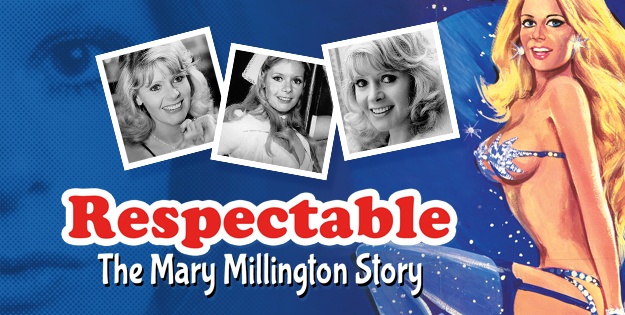
You recently wrote, directed and produced your first film, Respectable - The Mary Millington Story at Pinewood. What was that experience like and how did it feel to be making your own film at Pinewood Studios?

Pinewood is an extraordinary place. On the outside it looks like a cluster of anonymous aircraft hangers, but you look behind the doors and you genuinely see magic being made. I was shooting scenes for my film - and doing all the post-production - in a tiny studio, right next door to Star Wars: The Force Awakens, which was quite a thrill. We’d have Stormtroopers walking past our door, and in my lunchbreaks I’d wander onto the Star Wars set and see the most astonishing things going on. And, at the time, I couldn’t tell anybody what I’d seen! Pinewood is rich with history and I’m very fortunate to have made my film there. To have made my first ever movie at Pinewood was certainly an experience I’ll never forget.

Can you tell me about any projects you have in the pipeline?

Actually I’ve just started pre-production on my next documentary. It’s not set in the ‘X’-rated world this time, although it is based in the 1970s, and there are definite overlaps with my previous project. It’ll be a quite a departure from Respectable – The Mary Millington Story, but there are parallels with Mary’s life. There is sex, showbiz, drama and unbelievable tragedy. All I’ll say it’s a story which has never ever been told before and it’s going to surprise a few people.

Finally, what's your favourite Carry On film?

Well, I’d say without a shadow of a doubt it’s got to be Carry On Behind. I love the contemporary Carry Ons far more than the ‘historicals’. Films like Loving, Abroad, Girls and Behind are so anchored to that particular period of early-1970s’ England – drinking beer, smoking fags, betting on horses, ogling pretty girls. I particularly love Carry On Behind, because, with the absence of Sid James, it really allows Kenneth Connor, Kenneth Williams and Peter Butterworth to shine. The scene where the sexually-frustrated Connor is trying to seduce Joan Sims, with the military music playing on the record player, is one of my all-time favourite scenes. It’s probably Connor’s best-ever performance. However, it’s Elke Sommer who gets the best dialogue. Her speech about "I am keeping a, how you say, dirty caravan. Therefore, I am going round camp looking for scrubbers,” makes me laugh every single time I hear it. I have the poster for Carry On Behind hanging in my hallway. My postman loves looking at it! It’s also one of the best British poster images of the era – the beautiful girl on the bike, flashing her knickers. In many ways that’s exactly what 1970s’ cinema was all about!


Simon’s book Keeping the British End Up: Four Decades of a Saucy Cinema (Titan Books) and his DVD Respectable – The Mary Millington Story (Simply Media) are both available now from Amazon.co.uk

Additionally, Respectable is now showing on Netflix in the UK, US, Canada, Australia and New Zealand.

You can follow me on Twitter @CarryOnJoan and also Facebook

Tuesday, 13 October 2015

Keeping The British End Up!


Keeping The British End Up: Four Decades of Saucy Cinema is a fascinating book in which author Simon Sheridan has compiled an exhaustive list of the very best, worst and everything in between that the British film industry produced in all things naughty. My primary interest is of course the Carry On films, so a lot of the content of Simon's book was completely new to me.

I confess straight away that I prefer my comedy a bit more innocent than some of the smut discussed here. I love the saucy seaside postcard humour of the early Carry Ons and my favourite aspects of all these films is neither the situations or the corny gags, but the wonderful casts of classic British character actors who give quality performances again and again. That's probably the one thing the best of the Carry Ons have in common with naughtier films in the genre - somehow they all managed to attract high quality actors.


I'm still amazed that so many classic character actors agreed to appear in what were, let's face it, pretty low budget, pretty badly written and sometimes pretty downright dreadful films! Yet throughout the course of reading Simon's book the roll call of familiar names is a striking feature. They include the likes of Joan Hickson, Diana Dors, Christopher Timothy, Irene Handl, Liz Fraser, Lynda Bellingham, Joanna Lumley, Joan Collins, Roger Lloyd Pack, Warren Mitchell, Jill Gascoine, Leslie Phillips, Chic Murray, Arthur Askey, John Le Mesurier, Judy Geeson, Harry H Corbett and Pamela Stephenson. Quite an array! 

Simon Sheridan's book provides a great introduction as to why the British have a long tradition of saucy humour and double entendres. We then get a run down of all the major cinematic releases in the genre between 1958 and the early 1980s before a discussion of why the saucy film industry died a death after that point. The final main chapter of the book gives us great potted biographies of the main players in the films featured, including many of the actors, actresses, writers, directors and producers. It was fascinating to read and learn so much about some of these extraordinary people.


Of course when we think of this particular genre, we immediately summon up an image of Robin Askwith's cheeky grin, incorrigible antics and sometimes a lot more besides! I love to hate the Confessions films. While they were almost certainly a phenomenon at the time and proved incredibly successful I ultimately loathe them for both stealing the Carry Ons' thunder and forcing the antics at Pinewood to become a lot more explicit. Away from the Confessions pictures, others of the genre included the handsome Barry Evans kick starting the Adventures of... films and Barry Stokes in the rather dreadful Ups and Downs of a Handyman (which also featured Carry On actresses Valerie Leon and Alexandra Dane). 

These films captured the spirit of the time and Simon Sheridan really understands them. You can tell he's a fan and appreciates them for what they are. There's a great deal of affection for the films, the stars and their legacy. As part of this book, Sheridan writes about some of the more X-rated examples which although fascinating to read about, are probably not for this blog!


The Carry Ons are mentioned in Simon's book - Emmannuelle is profiled as probably the only series entry that can be classed as seriously naughty. Thankfully Simon agrees with me that the film is pretty dreadful and the likes of Butterworth, Williams, Connor and Sims are not only out of place but completely wasted in that mess of the movie. While the Carry Ons obviously set the tone for the relaxing of attitudes in British cinema, Barbara Windsor's bra popping in Carry On Camping quite quickly lost its shock value as the 1960s ended the saucy 70s came along.

I would recommend Keeping The British End Up to all fans of British cinema and classic British comedies. It's a wonderful time capsule and provides a really entertaining social history of a climatic period in our recent history. As always, the films produced at a certain time really do speak volumes about the times in which they were made.


Thank Simon, and long may he keep his end up! 

You can visit Simon's website here: www.simonsheridan.com 
Simon is also on Twitter: @SJASheridan 


You can follow me on Twitter @CarryOnJoan and also Facebook

Clicking on the adverts helps to keep this blog going.